
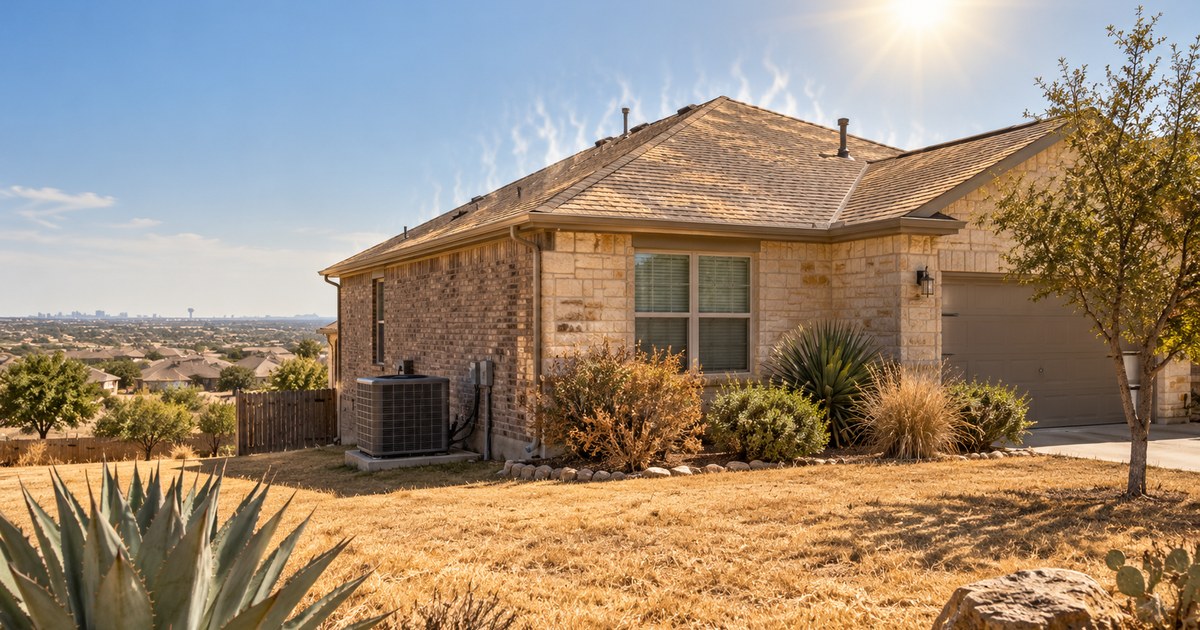
What a Texas Summer Actually Costs Your House
A hundred-degree afternoon in north Texas does not just make the house uncomfortable. It applies sustained mechanical stress to every system in the building, and the bill for that stress does not arrive in August. It arrives eighteen months later as a compressor failure, a roof that aged out five years early, or a water heater that quietly gave up.
Homeowners tend to treat summer as something to endure. It is more useful to treat it as a load test, and to know what the test is actually measuring.
Cooling equipment is running near its design limit for months
Air conditioning systems are sized against a design temperature, the outdoor condition the equipment is expected to handle while holding a target indoor temperature. In this region that number sits in the high nineties. When outdoor temperatures spend weeks above it, the system does not fail. It simply stops cycling off.
Continuous runtime is where the wear happens. Compressors accumulate hours, capacitors degrade under heat, and contactors pit. A unit that runs twelve hours a day for four months has aged considerably more than the calendar suggests. This is why so many failures cluster in late July and August: the equipment did not break because of a single hot day, it broke because of the ninetieth one.
The maintenance that matters here is unglamorous. Clean filters, so the system is not fighting restricted airflow. A clean outdoor coil, so it can actually reject heat. Correct refrigerant charge, because a system running low works harder for less output and does it at higher compressor temperatures.
Roofs age in heat, not just in storms
Asphalt shingles fail from ultraviolet exposure and thermal cycling long before most homeowners expect. Roof surface temperatures well above the air temperature soften the asphalt binder during the day and let it harden again overnight. Repeated thousands of times, that cycle drives granule loss and makes shingles brittle.
The practical consequence is that a shingle roof in this climate does not get the service life printed on the wrapper. It gets less. And a roof already weakened by heat is meaningfully less able to survive the hail that arrives with the spring and fall storm seasons.
Attic ventilation is the lever most homeowners have available. Poor ventilation traps heat against the underside of the deck, accelerating that aging from both sides, and simultaneously raises the cooling load on the equipment below.
The two problems are the same problem
This is the part that gets missed. A house that struggles to stay cool is often diagnosed as an equipment problem when it is an envelope problem. Compressed or insufficient attic insulation, a poorly ventilated attic, and gaps at penetrations all push heat into the conditioned space, and the cooling system responds by running longer.
Replacing that system with a larger one treats the symptom and raises the operating cost permanently. Fixing the attic often does more for comfort than new equipment would, at a fraction of the cost.
The only way to know which situation you are in is to have someone look at both the mechanical system and the building envelope in the same visit.
Plumbing has a summer failure mode too
Extended dry heat moves soil. In areas with expansive clay, that movement puts stress on buried supply and drain lines and on slab foundations. Slow leaks under a slab often first show up as an unexplained jump in water usage, a warm spot on the floor, or the sound of water running when every fixture is off.
Water heaters also work harder in summer than people assume, because incoming supply temperatures and ambient garage temperatures both shift. A unit already carrying sediment is more likely to fail during this period.
What to actually do
Before the peak, replace filters on schedule and clear vegetation and debris from around the outdoor unit. Check that attic insulation is at an appropriate depth and has not been compressed or displaced by earlier work. Look at the roof from the ground for lifted, curled, or missing shingles, and check gutters for granule accumulation.
After the peak, watch for the systems that just spent four months at capacity: a cooling system that is noticeably louder or slower to recover, a water heater making new noises, water bills that do not match usage.
Homeowners who want the mechanical systems, the roof, and the plumbing assessed together rather than in three separate visits can arrange that through Custom Cooling in Frisco, Texas and get a single picture of what the summer cost the house.
None of this is dramatic. It is the difference between replacing equipment on your schedule and replacing it on the hottest afternoon of the year.
Leave a Reply